– Prem Darshan Sapkota and Srishti Adhikari
Findings of the Survey
Youth Understanding of the Agenda of the Gen-Z Movement
In the survey, 61.3 percent said that the main agenda of the Gen Z movement was anti- corruption. 26.3 percent said it was because social media had been shut down, 8 percent said it was for political system reform, and 4.4 percent said it was for changing the government. The options such as ending the dominance of certain leaders, putting pressure for constitutional amendment, and others were not mentioned by anyone.

Youth Perception of the Agenda of the Gen-Z Movement
In response to the question of how the agenda raised in the Gen-Z movement seemed to them, the highest proportion—60.6 percent—said it was reformative, while 29.2 percent said it was transformative. Likewise, 3.6 percent described it as anarchic, and 2.2 percent said it was negative. Similarly, 2.2 percent responded that they did not know, while another 2.2 percent said they did not want to say.

Youth Perceptions on What the Interim Government Should Do to Address the Movement’s Agenda
Regarding the question of what the interim government should do to address the agenda of the movement, the highest proportion—50.4 percent—answered that there should be immediate investigation into corruption scandals. Similarly, 35.8 percent said that the government should focus on holding elections, while 8.8 percent responded that those involved in the incidents of September 8 and 9 should be prosecuted. Likewise, 4.4 percent said that the shooting incident of September 8 should be investigated and those involved should be prosecuted. A total of 0.6 percent responded with “other.”

Youth Perception on Future Changes Resulting from the Gen-Z Movement
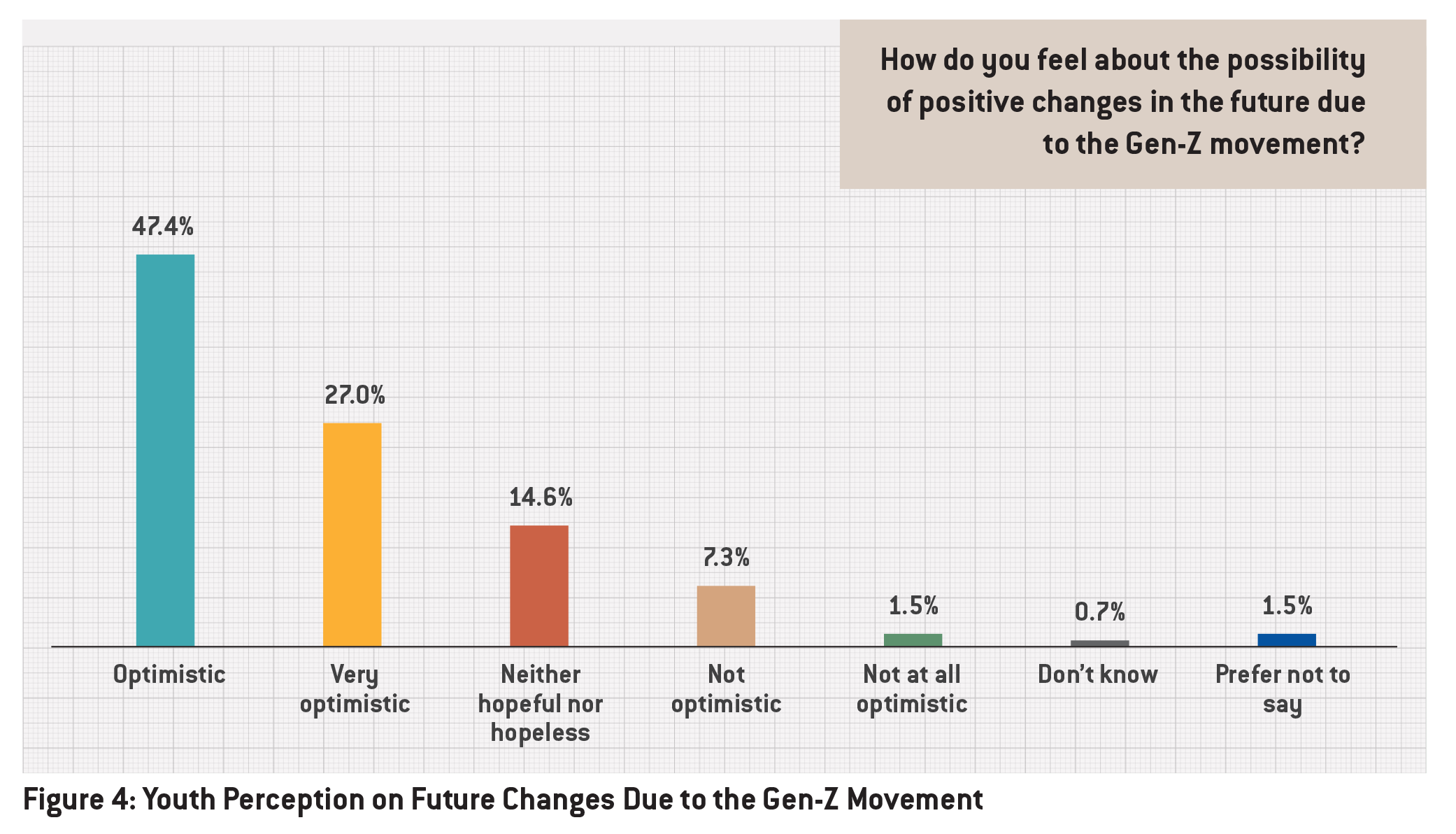
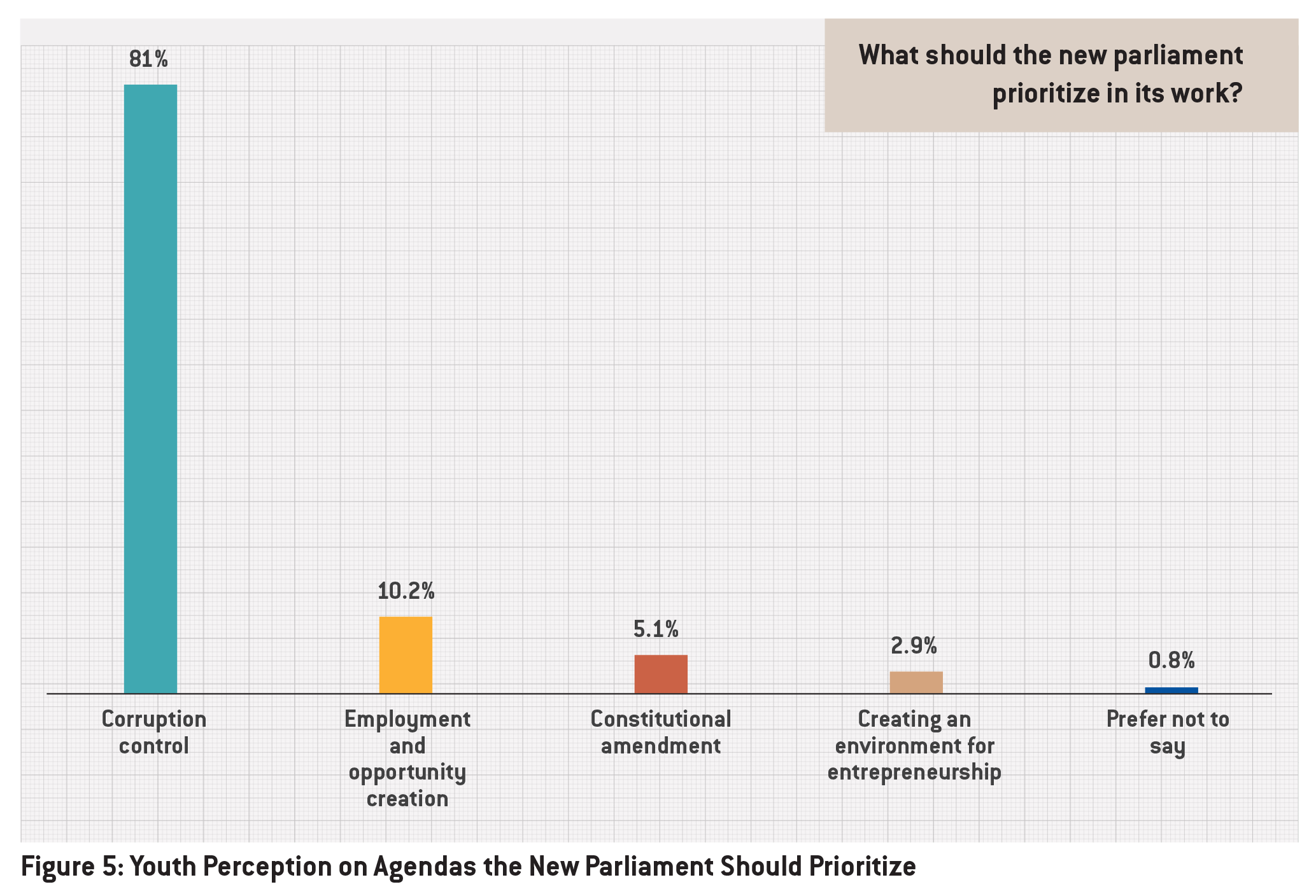
Youth Perception on the Agenda the New Parliament Should Prioritize
Youth Perception on What the Gen-Z Groups Should Do Next

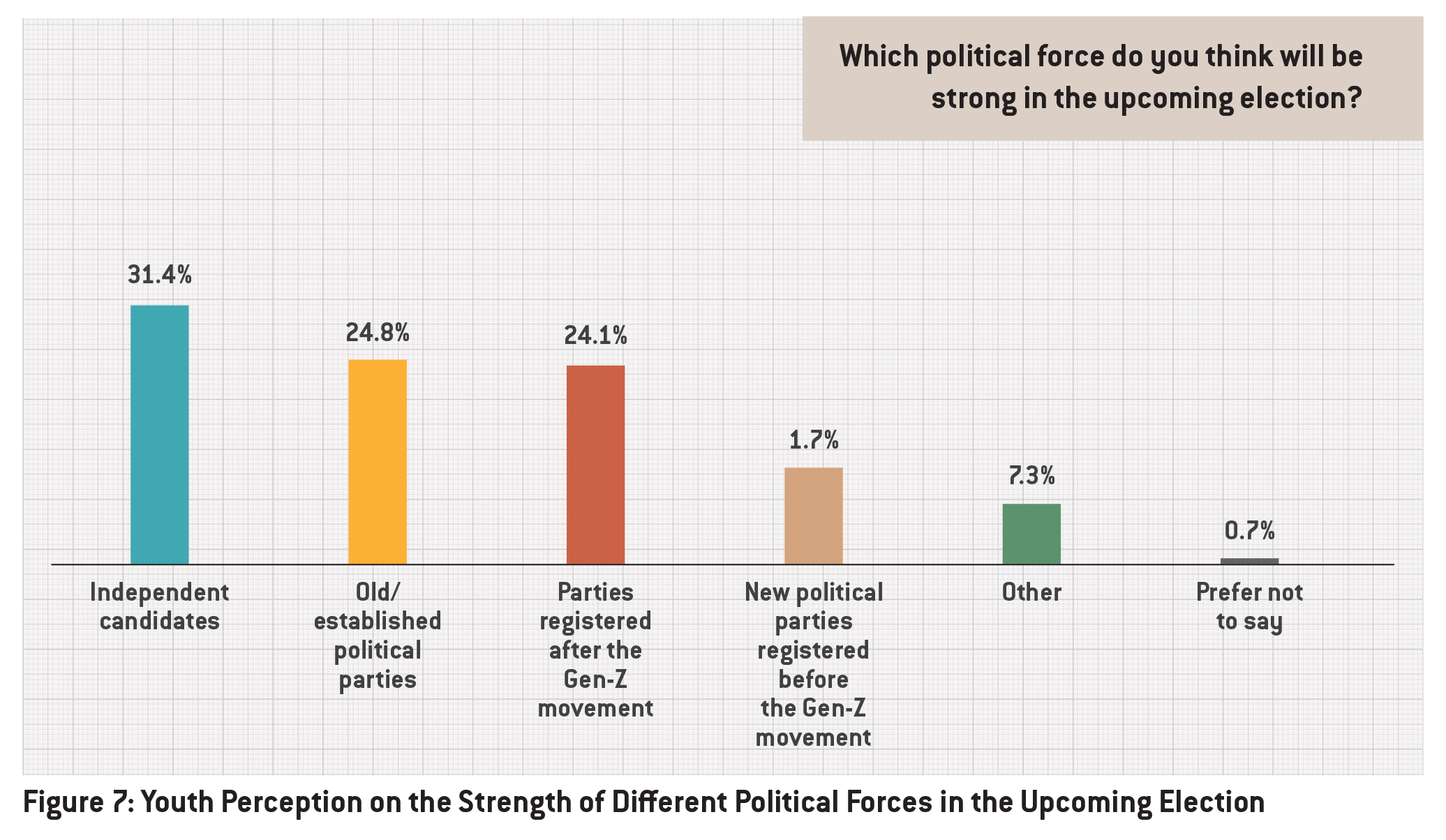
Youth Perception of the Strength of Different Political Forces in the Upcoming Election
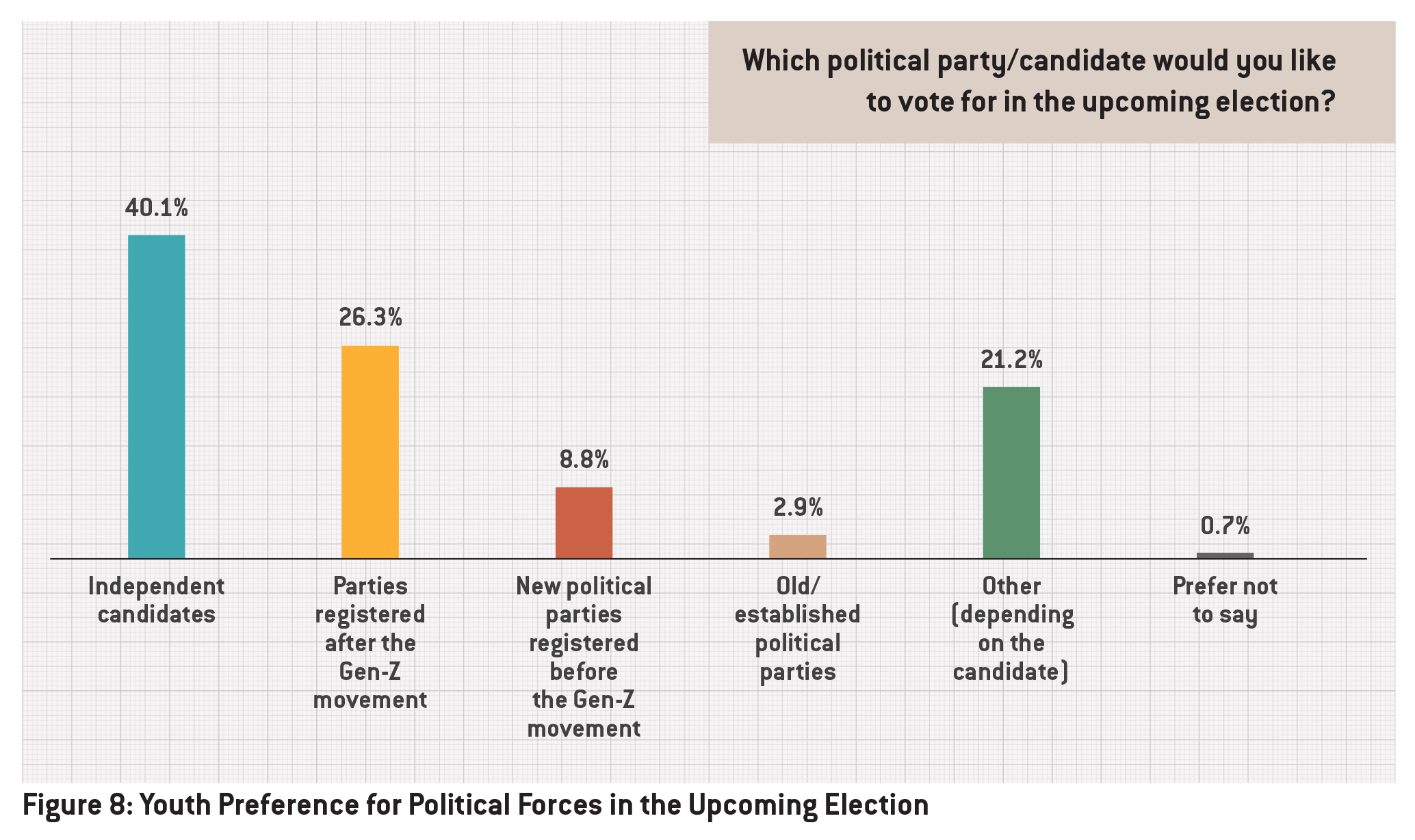
Youth Choice of Political Force in the Upcoming Election
Discussion
A strong public opinion has existed for years that corruption is an obstacle to the progress of Nepali society. Previous citizen surveys have also identified corruption as a major problem. According to a survey conducted in Gandaki Province on public service and good governance, more than 90 percent of citizens believe that political leadership has abused power, position, and authority, protected corrupt individuals, favored their close associates while in government, and colluded with other political parties in major corruption cases. Similarly, 76 percent of citizens believe that government contracts are given to close associates, 86.5 percent believe nepotism and favoritism dominate government appointments, and 92.9 percent believe that appointing close associates over competent individuals in public positions does not result in effective work.
The results of another survey on Madhesh, Lumbini Province, and the Kathmandu Valley, are similar. According to the survey, 92.9 percent believe that political leadership has abused power and position, 93.2 percent believe close associates are favored while in government,
91.3 percent believe government contracts are given to party workers and supporters, 91.8 percent believe appointing close associates over competent individuals in public positions has not resulted in effective work, 89.9 percent believe nepotism and favoritism dominate government appointments, 89.1 percent believe political leaders protect corrupt individuals, and 90.2 percent believe political parties collude in major corruption cases. Over the past decade, the dominance of the same type of political leadership is commonly understood to have strengthened the cycle of corruption.
The Gen-Z movement has raised this issue prominently. Nearly two-thirds of the youth approached in the survey reported corruption as the main agenda of the Gen-Z movement. As for addressing the movement’s demands, youth believe the interim government should conduct rapid investigations into corruption scandals and focus on elections. Similarly, 81 percent of youth say that the new parliament should prioritize controlling corruption, showing that the question of who can/will control corruption ranks uppermost in today’s youth.
The youth are also positive about the agendas raised in the Gen-Z movement. The fact that
60.6 percent consider the movement reformative and 29.2 percent consider it transformative shows they view the movement as a positive event. Furthermore, 74.4 percent of youth are optimistic that the Gen-Z movement will bring positive changes in the future.
To address the issues raised by the movement, 77.4 percent of respondents said the Gen-Z groups should continuously monitor the government and political parties as a civic group, while only 10.2 percent said they should form a political party and contest elections. This shows that youth want the Gen-Z movement to strengthen the civic voice against any irregularities rather than directly entering politics themselves.
After the Gen-Z movement, perspectives on pluralism and political parties appear to have developed differently. Youth express frustration that political party cadres and elected representatives are more accountable to party leadership than to citizens. This may explain the growing inclination toward independent candidates. Nearly one-third believe independent candidates will be strong in the upcoming elections, and 40.1 percent say they would vote for one.
Young people feel that the elected representatives so far have been unable to raise citizens’ issues in the parliament or hold their leadership accountable. Many firmly believe that the representatives should not serve the interests of only a few leaders. This is the basis for their belief that a directly elected executive would be accountable to citizens than the party leadership. The appeal of independent candidates is further strengthened by the perception that independent mayors can carry out their duties towards their constituencies without direct political party interference.
However, youth are also open to making their decision based on the candidates that are fielded by the parties. At the local level, youth who participated in the Gen-Z movement are observing how the new political scenario develops. They plan on deciding their involvement based on how new political parties or groups emerge. In the survey, 21.2 percent said they have not yet decided which side to vote for, indicating that they prefer to judge candidates rather than parties. While some youth favor parties registered after the Gen Z movement, others are keen to support the newer parties from the previous elections. However, there is a marked lack of interest in the traditional established parties amongst this group. Youth are wary that the traditional parties if they gain a majority, may exact revenge on the protesters.
Youth are seeking leadership that can control corruption, create economic opportunities, and formulate policies accountable to citizens. The process of searching for options continues— but the question of whom to trust remains open.