Citizen Perspectives on the First Three Months of the Balen Shah Government
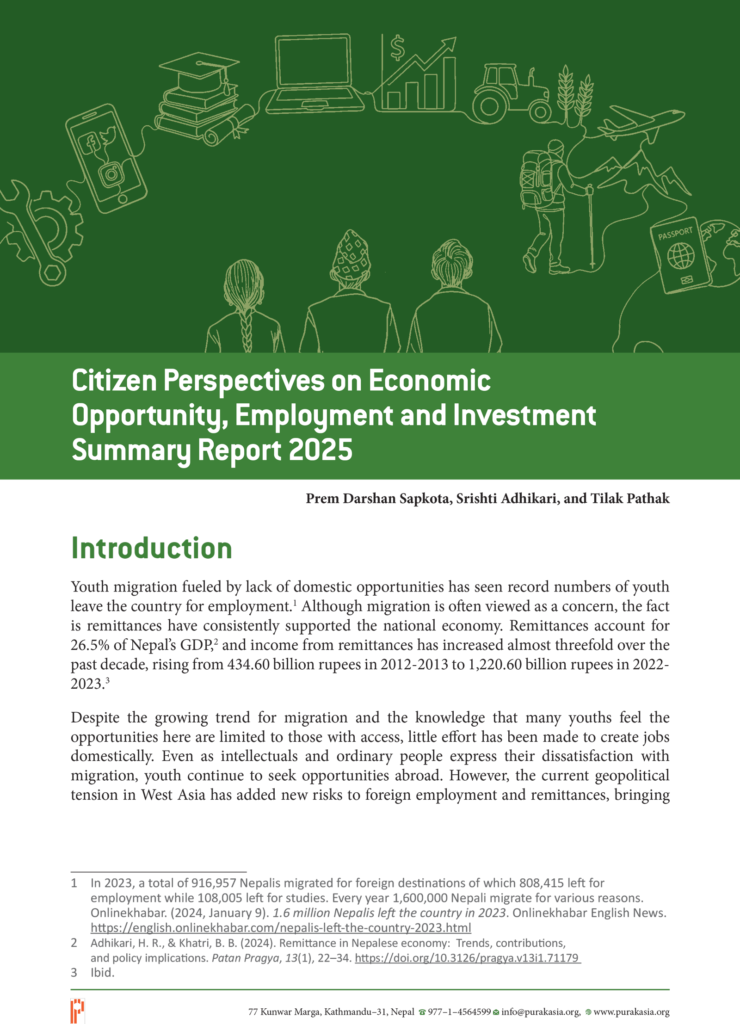
Citizen Perspectives on Economic Opportunity 2025
This is a summary of our comprehensive report, “Citizens’ Survey on Opportunity, Investment and Employment 2082”. Based on a public opinion survey of 1,426 citizens across Madhesh Province, Lumbini Province, and the Kathmandu Valley, this report examines perceptions of economic opportunities, employment prospects, and investment priorities. Key areas of focus include factors driving youth migration, barriers to employment, confidence in entrepreneurship, and urgent sectors for investment.
By capturing citizens’ experiences and expectations, this report offers valuable insights for policymakers, development practitioners, researchers, and stakeholders seeking to promote inclusive economic growth and expand opportunities for all Nepalis.
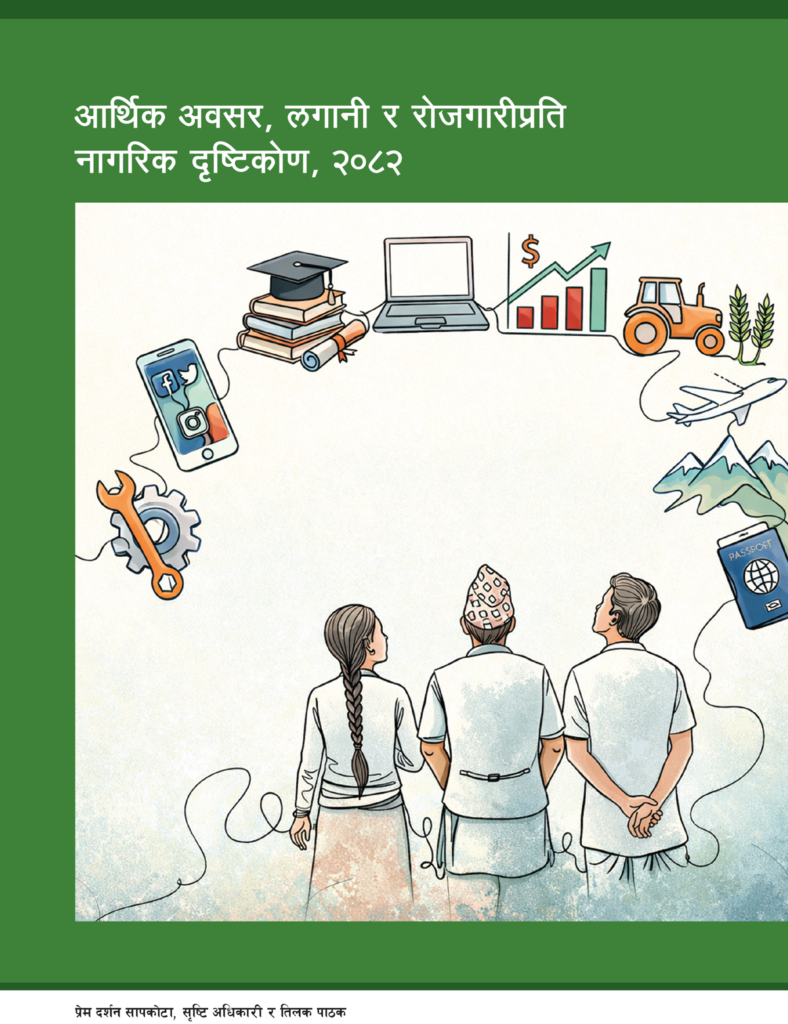
This publication offers a comprehensive comparative analysis of perspectives on economic opportunities, investment, and employment across Madhesh Province, Lumbini Province, and the Kathmandu Valley. Drawing on responses from 1426 participants, it provides an in-depth analysis of respondents’ views on the environment for employment and entrepreneurship, their hopes for the future, factors impacting business confidence, and key areas for investment.
Citizens’ Perspectives on Public Opinion Formation, Political Parties, and Leadership (2082)
This survey offers a comparative analysis of public opinion across Madhesh Province, Lumbini Province, and the Kathmandu Valley. It examines evolving sources of information, patterns of opinion formation, and citizens’ perceptions of political leadership, governance, and constitutional reform.
The findings indicate a growing influence of social media relative to traditional news outlets, alongside a marked decline in public trust in political parties. There is an increasing demand for change in political leadership—both within established parties and beyond them. Although dissatisfaction with ongoing government instability remains widespread, there is notable public support for constitutional amendments.
The results reflect a strong call for renewed leadership and a continued commitment among citizens to exercise their voting rights, in hopes of achieving accountable and effective political governance.
Connected but Fragmented: The State of Internet Governance in Nepal
This publication is an occasional paper of Purak Asia. It presents findings from study into the current state of Nepal’s internet governance ecosystem. It identifies key actors, their roles in policy making and impact, and interrelations between these actors. This report seeks to understand the various factors and dynamics that influence Nepal’s policy making around internet use, shape public dialogue, and identify avenues where stakeholders can make impactful contributions.
Understanding Misinformation in Nepal: Expert Views on Definitions, Determinants, Solutions and Way Forward
This occasional paper by Purak Asia explores how experts in Nepal define and interpret misinformation, why people believe and share it, and what interventions may work to counter its spread. Based on insights from digital issue experts, the study highlights the growing influence of social media and political actors in shaping false narratives, the societal risks posed by misinformation, and the urgent need for evidence-based solutions. It provides critical insights for researchers, policymakers, and practitioners seeking to strengthen the information ecosystem.

State, Citizens and Landlessness at the Margins of Western Nepal
Annotated Bibliography on Food Sovereignty in Nepal

Economic Opportunity Survey: Gandaki 2082
This survey examines the current landscape of economic opportunities in Gandaki Province, focusing on employment, business, and investment. It captures the lived experiences and perceptions of citizens regarding the broader environment for investment, entrepreneurship, and job creation across Nepal.
The findings reveal that many respondents view the national investment climate as unfavorable for new ventures. Many reported challenges in finding employment that matches their educational qualifications, underscoring a persistent gap between formal education and labor market demands. Additionally, there was an overwhelming agreement that limited domestic opportunities are driving today’s youth to seek employment abroad.

Public Service and Good Governance Survey: Gandaki 2082
This survey captures the perspectives of citizens in Gandaki Province on the quality of public services, the state of governance, and the performance of government institutions. It also assesses the degree to which local democracy is participatory and inclusive.
The findings indicate that while satisfaction with services provided by local government offices is relatively high, significant concerns remain regarding governance. Many citizens perceive a persistent culture of irregularities and a lack of accountability among those in positions of power. The study also underscores the fragile state of essential checks and balance mechanisms that are critical for ensuring transparency, integrity, and trust in governance.

Citizen Dissatisfaction Survey – Gandaki 2082
The survey explores the issues that citizens in Gandaki Province are dissatisfied with, the underlying causes of this dissatisfaction, and the ways in which it is expressed. In doing so, it aims to offer insights into how democratic governance is perceived and evaluated by the general public.
The survey findings reveal that the main causes of citizen dissatisfaction include a lack of overall economic opportunities, large-scale youth migration abroad, and entrenched institutional corruption. The respondents expressed major dissatisfaction with the political parties, the parliament and the federal and provincial government. Despite their dissatisfaction with the major players in the democratic system, they voiced clear intent to find a democratic solution: by changing their vote in the upcoming elections.
Right to Food and Food Sovereignty Act 2075 - Status of Implementation and Legal Provisions
Compilation of Selected Landmark Human Rights Decisions in Asia

Voices of Discontent:

Elections and Democracy in Nepal:
This publication is the first of the occasional paper series of Purak Asia. It offers a comparative view on the progress made or the lack thereof in the four subsequent elections in the last 14 years in Nepal. The writers use the five pillar interactive election framework on the two elections for the Constituent Assembly in 2008 and 2013 and the elections for the House of Representatives in 2017 and 2022 to see whether and how elections have helped in the maturing of democracy in Nepal.